

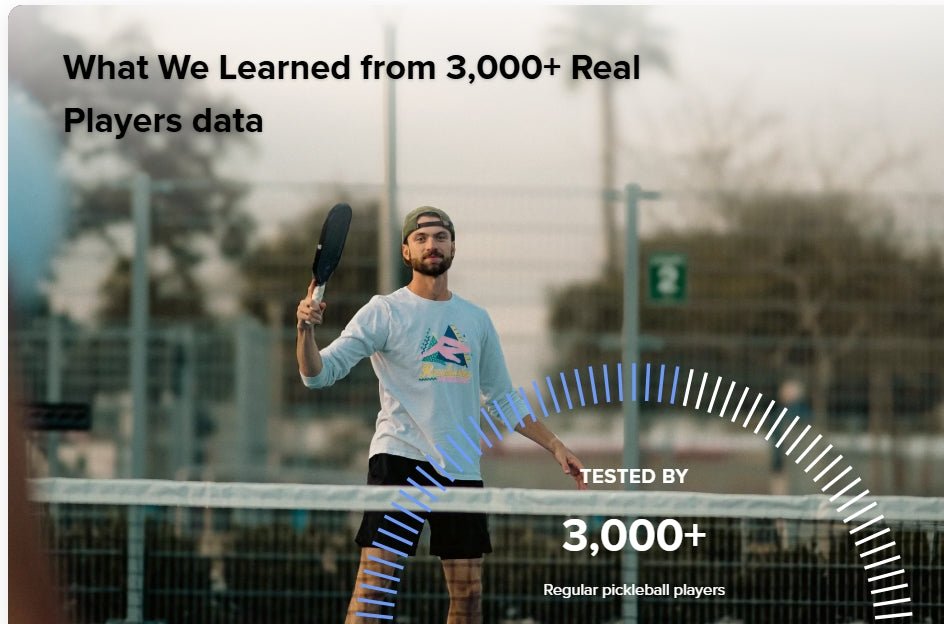
What the Data Really Says About Winning in Pickleball — And How Your Paddle Could Be Holding You Back
Every pickleball player has been there: a missed shot by inches, a rally lost after a good serve, or a ball that flies off your paddle’s edge like it had a mind of its own. What if you could actually see the patterns behind those misses? What if you could design your paddle around the data?
At Rift Pickleball, we’ve been building our paddles using real-world data from thousands of matches, and in the process, we’ve uncovered insights that can help any player—whether you're playing rec games at the park or trying to win gold in your next tournament.
Let’s break it all down.
1. Where Are People Actually Hitting the Ball?
Let’s talk about paddle contact zones. According to a meta-analysis we compiled from gameplay and our own testing:
-
61% of shots hit the sweet spot
-
23% are slightly off-center
-
7% hit the edge
-
9% result in outright misses
That means nearly 40% of contact is less than ideal.
What this means for your game: If your paddle’s sweet spot isn’t forgiving—or worse, doesn’t feel consistent—you’re leaving performance on the table. Or court.
How Rift uses this: We widened our paddle face and optimized weight distribution to reduce the penalty of off-center hits. Not only that, we tested angle deviation from dead-drop bounces across various materials. Our cold-press honeycomb core offered ball rebound angles between 4°–11°, whereas foam-core paddles showed variation up to 30°, indicating potential inconsistency during real gameplay. That’s not marketing—it’s physics.
2. Serves and Returns: Who’s Making the Most Mistakes?
A breakdown of errors by shot type and skill level reveals a massive performance gap:


-
Serve Errors: Pros: 0.99%, 4.5 Players: 1.88%, 3.5 Players: 3.82%
-
Return Errors: Pros: 2.78%, 4.5 Players: 4.7%, 3.5 Players: 6.01%
-
3rd Shot Drop Errors: Pros: 5.79%, 4.5s: 9.21%, 3.5s: 11.08%
That’s not all:
-
30% of points are lost on the return alone
-
49% of errors come from the 4th shot
-
Unforced errors account for over 63% of points in total
What this means for your game: Most of your mistakes probably aren’t happening during highlight-reel points—they’re happening early. And often, quietly.
What Rift did with this: We focused on enhancing control and spin at low swing speeds. By optimizing the paddle’s dwell time and balancing the paddle weight precisely, we made it easier to return tough serves and execute soft 3rd shots under pressure.
3. Drives vs Drops: The Stats Are Surprising

You’ve probably heard that drops are the gold standard. But according to data from high-level rec and tournament play:
-
Drives win 43% of rallies
-
Drops win 39%
Drives carry a higher error rate, but they lead to more point conversions—especially for 3.5–4.0 level players.
What this means for your game: You don’t have to be a drop purist. A smart mix of both works—especially if your paddle can deliver drive power and soft touch.
How Rift adapted: We used a proprietary cold-press technique that fuses the carbon face without overheating it—preserving elasticity while improving stiffness. This lets us achieve better dwell time for drops while maintaining the pop needed for strong drives.
4. Hands Battles: Where Matches Are Won
In fast hands exchanges (you know the ones), winning players:
-
Win up to 30% more points overall
-
Tend to make fewer grip-pressure errors (studies showed player grip can range from 3 psi to 10 psi)
What this means for your game: Comfort and maneuverability during hand speed duels is crucial. Fatigue, tension, or a clunky grip? Say goodbye to those points.
How Rift adapted: We discovered players with lighter grip pressure tended to maintain performance longer and fatigued less. That led us to reduce overall paddle weight, and implement layered materials in the handle for a more forgiving grip zone. It might seem minor, but reducing the physical grip load had a measurable impact on player consistency over long rallies.
5. The Most Common Shots — and Why They Matter
Based on aggregated match data:
-
28% of shots are dinks
-
24% come from the transition zone
-
12% are hands battles
-
11% serves and 11% returns
-
Only 6% are 3rd shot drops and 4% 3rd shot drives
What this means for your game: You’re spending nearly 75% of your time not doing highlight shots. Your paddle should help you win the boring ones too.
What Rift considered: We engineered our paddle face to perform consistently across the widest variety of shot types—not just the ones that show up on Instagram.
6. Spin, Control & Dwell Time — The Real Differentiator
We define dwell time as the number of milliseconds the ball remains in contact with the paddle surface. This is the window in which you’re able to influence spin and direction.
Through deflection and high-speed camera testing, we found that:
-
Even minor increases in dwell time boost control and spin potential.
-
Cold press paddles with honeycomb cores performed best in consistency and rebound control.
-
Foam core paddles delivered higher dwell time but at the cost of bounce angle consistency—sometimes launching at unpredictable angles up to 30°.
What Rift did: We engineered a layered T700 carbon surface with controlled texture and used a heat-assisted cold press to maximize legal dwell time without rebound irregularities. The first thing testers mention is usually the added spin—not because we told them, but because they feel it.
7. Why This Data Matters
This isn’t just about paddle design—it’s about understanding how people really play. The average pickleball player is now 38.1 years old (down from 41), and competitive players skew even younger. Players are faster. The game is evolving.
Most paddle companies still design for what one pro wants. We built Rift around what thousands of real players actually do.
Our founder, Jason Maynard, is a full-stack software engineer who’s worked on enterprise-grade IoT systems. He applied that background to build a prototype smart paddle using embedded sensors and a custom-trained machine learning model to predict ball impact zones. The data we collected has shaped everything from face geometry to future R&D planning.
What’s next? We’re prototyping a Gen 2 paddle that sandwiches a 0.5mm foam layer between the carbon surface and honeycomb core. The goal is to increase dwell time without sacrificing bounce predictability—a technical challenge we’re still solving through controlled experiments.

Bonus: Are You Playing Like the Stats Say You Should?
We’re releasing a quiz next week to help you match your playing style to your strengths (or expose a few weaknesses). Want in?
👉 Join the Rift newsletter and be the first to get it.
Final Thoughts
If you’ve ever felt like your paddle wasn’t working with you—it probably wasn’t. Most players lose points not because of strategy, but because they didn’t know where their paddle was holding them back.
This data changes that.
We’re not just building paddles. We’re helping players evolve with the game. If that sounds like you, we’d love to have you test the Rift 1 Pro.
→ Or dive deeper into our process
Play smarter. Not harder.
Sources:
-
https://www.tandfonline.com/doi/full/10.1080/24748668.2025.2457223
-
https://www.gaithersburgpickleballclub.com/blog/pickleball-statistical-analysis-unforced-errors
-
https://www.theapp.global/news/nearly-50-million-adult-americans-have-played-pickleball
-
Internal Rift testing from gameplay trials and product development

Written by Jason Maynard

Leave a comment
This site is protected by hCaptcha and the hCaptcha Privacy Policy and Terms of Service apply.